Zellesia
The South Pacific archipelago hosting the British Embassy in RANK.
| Capital | Robi |
|---|---|
| Government | Rotating carousel |
| Supreme Leader | Recovering since 2018 |
| Official languages | French, Spanish, English |
| Currency | Inherited from France |
| ISO code | ZE / ZLS |
| Calling code | +694 |
| Area | ~2,340 km² |
Overview
Zellesia is a South Pacific island nation shaped by a comedic post-colonial identity: three colonial languages left over from a crowded scramble for the region, three separate national holidays each claiming to be "the real" independence day, and a currency nobody quite remembers agreeing to keep.
Leadership
Zellesia's Supreme Leader has been officially "recovering from a cold" since 2018, having been effectively incapacitated the entire time. In his absence, the country is run by a rotating carousel of officials with no clearly defined chain of command — a structure that makes every visiting diplomat's first question ("who's actually in charge here?") permanently, sincerely unanswerable.
Foreign Policy
Zellesia's foreign policy is built in part on a sincere misunderstanding of the "Axis of Evil" as a formal intergovernmental organization it might apply to join — one of several ways the nation's global ambitions outpace its grasp of how the world actually works.
Geography
The nation spans roughly 2,340 km² across three main islands plus eleven smaller islets, home to two volcanoes — Mount Kaeloa (1,850m, active) and Mount Verrou (dormant) — and a smaller active islet, Cendre Ceniza. The archipelago also holds two lakes, twenty-three beaches, and three named working ports.
Early Settlement
Indigenous settlement dates to roughly 1000 BCE with the arrival of Melanesian peoples, followed by a Polynesian wave around 800 CE. The indigenous Talei people remain central to Zellesian identity today, with traditional tapa cloth, obsidian carving, and outrigger canoe-building still practiced.
Economy
The economy rests officially on "zellesite" ore — the mineral basis for the nation's nuclear ambitions, though independent surveys consistently undercut the government's claims about its abundance. Primary sectors otherwise include fishing, a modest tourism industry marketed under the slogan "Three Empires, One Island," and a growing offshore paperwork-processing industry that trades on the nation's centuries of colonial bureaucratic tradition.
Nuclear Ambitions
Zellesia maintains nuclear ambitions that are aspirational at best and technically implausible at worst, propped up by those same modest deposits of low-grade zellesite ore — enough to fuel a national mythology, not a weapons program.
Education
The University of Robi, founded in 1952, anchors the nation's education system. Its science division carries the semi-official nickname "the Institute of the Flame."
National Flag
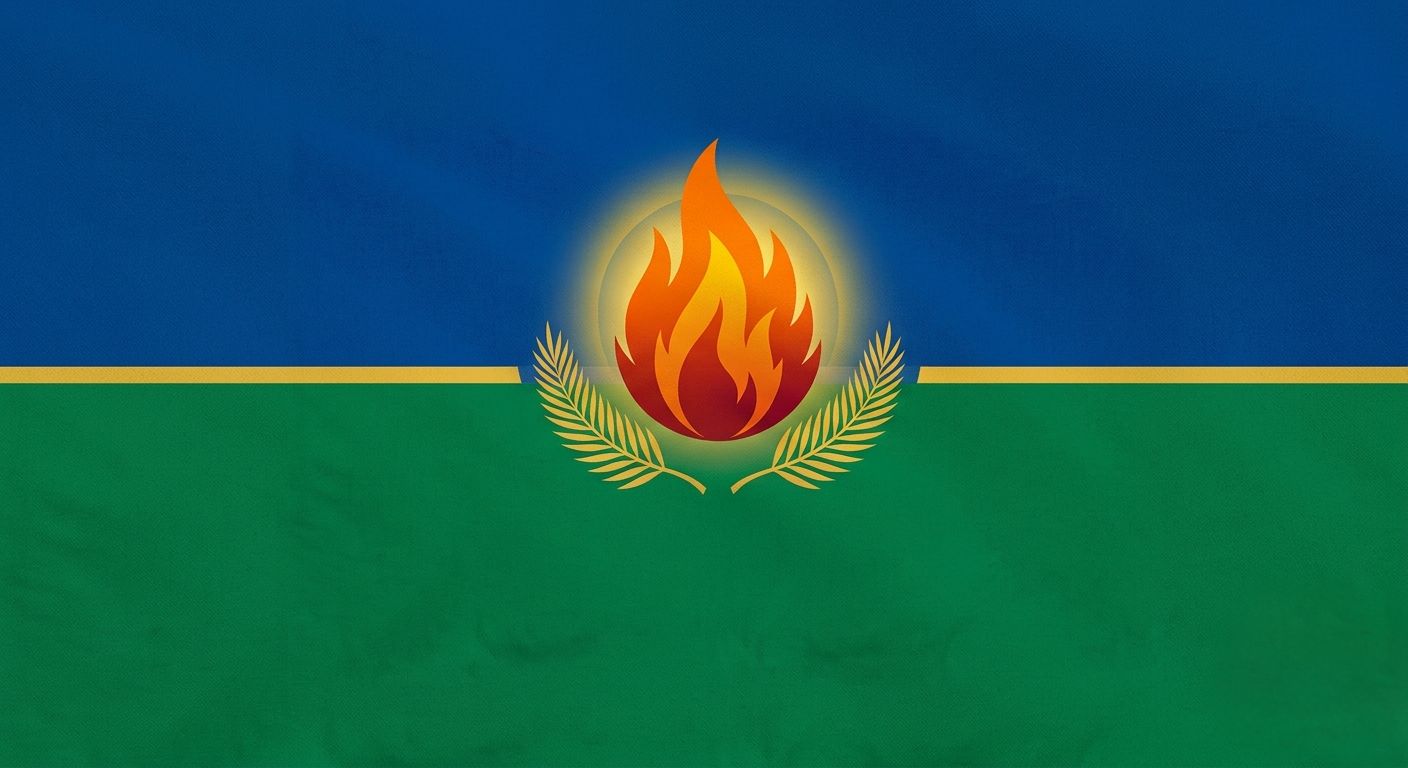
Zellesia's flag is divided horizontally into blue and green, separated by a thin gold band, with a central emblem of a flame cradled by two crossed feathers, rendered in gold, orange, and red. The blue represents the archipelago's clear skies; the green, its lush tropical interior. The gold band represents the nation's wealth — iconography many note is somewhat aspirational given the state of the treasury. The flame refers to the archipelago's active volcanoes, chiefly Mount Kaeloa, and is echoed in the national anthem. The two feathers are a traditional Talei symbol of peace, sitting in permanent, unresolved contrast with the state's periodic nuclear announcements.
National Flower
The Kaeloa Firebloom (Hibiscus ignikaeloa) is a hardy hibiscus variant found only on the archipelago's volcanic slopes, its deep orange-to-red petals echoing the flame motif in Zellesian iconography. It blooms most heavily around Flame Day — timing the Ministry of Culture insists is symbolic and botanists insist is simply the local growing season.
National Anthem
"March of the Zellesian Flame" is performed in rotating verses across all three official languages — French, Spanish, and English — a compromise reached after decades of dispute over which colonial tongue should have primacy. The full anthem is sung only on state occasions; abbreviated single-language versions are used for everyday events.
National Holidays
| Date | Holiday | Notes |
|---|---|---|
| 1 January | Flame Day | Marks the disputed date of Mount Kaeloa's last confirmed eruption; fireworks imitate the volcano |
| Movable, March | Heritage Month opening ceremony | Opens the month-long, three-culture heritage observance |
| 14 July | French Independence Day | One of three competing independence days; military parade |
| 12 October | Spanish Independence Day | Observed mainly on the outer islands |
| 3 December | British Independence Day | The third and most recent; observed primarily in Robi |
| 19 August | Founders' Day (University of Robi) | Marks the university's 1952 founding |
| 30 November | Talei Heritage Day | Canoe races on Lake Kaeloa and tapa-cloth exhibitions |